You pay for health insurance every month. You are healthy and rarely see a doctor. Then your renewal arrives, and the price has gone up again. When you do need care, there’s still a deductible to meet and you never see any money from the insurance. It’s hard not to wonder: where is all that money going? Your premium doesn’t just pay for your own care. It helps cover everyone in your insurance pool. To understand why it costs so much, we need to follow that money.
The US spends more money per patient on healthcare than any other country in the world. Not 10% more. About 50% more than the next-highest-spending country. We spend roughly $15,000 per person a year, while Switzerland spends $10,000 in the second spot. Despite spending the most, we have rather mediocre life expectancy. Every individual that has to pay for their own health insurance premium is asking how can it be that coverage for a family of 4 in California costs $3,400 a month, with an $8,000 deductible. I will try to expand where that money goes.
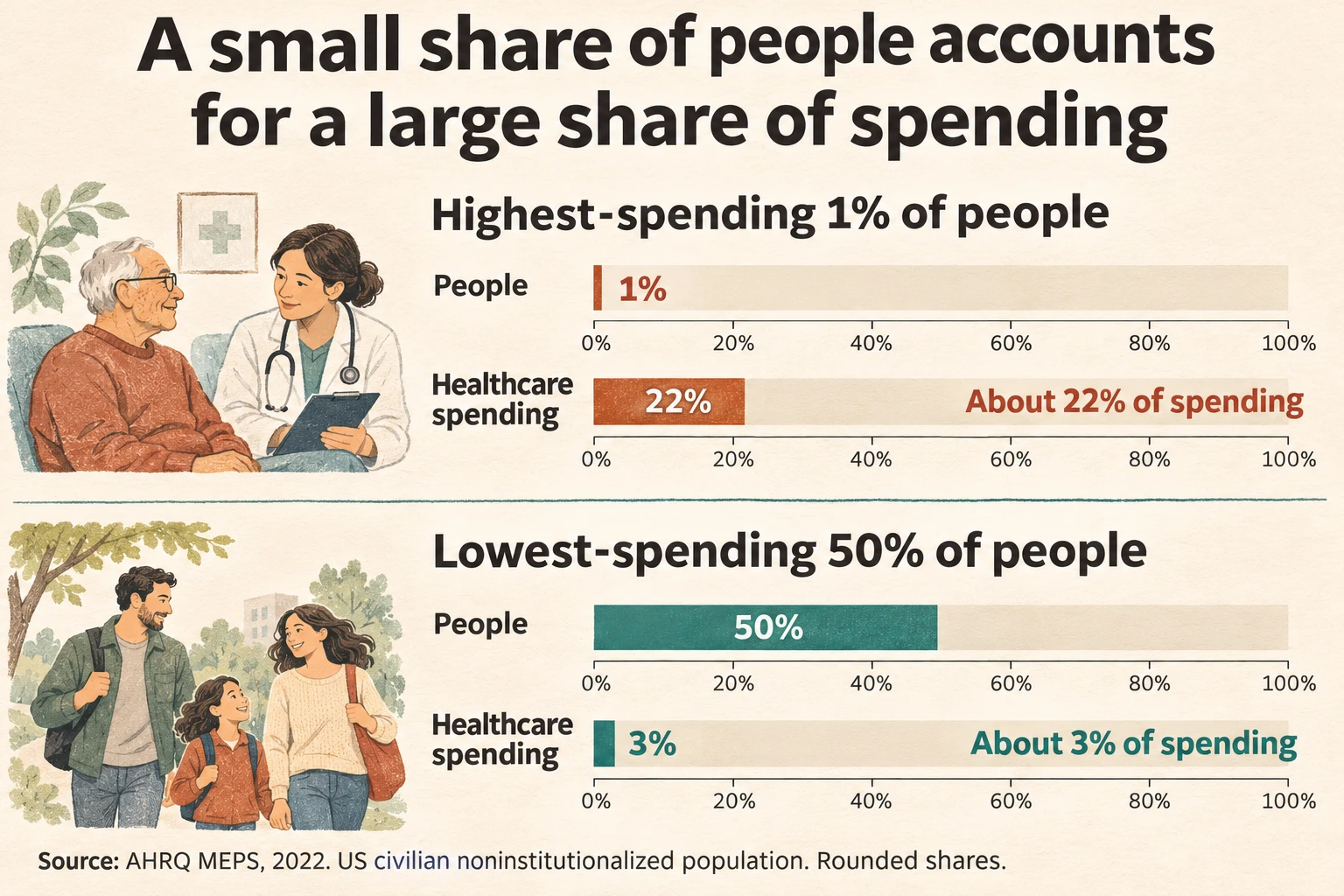
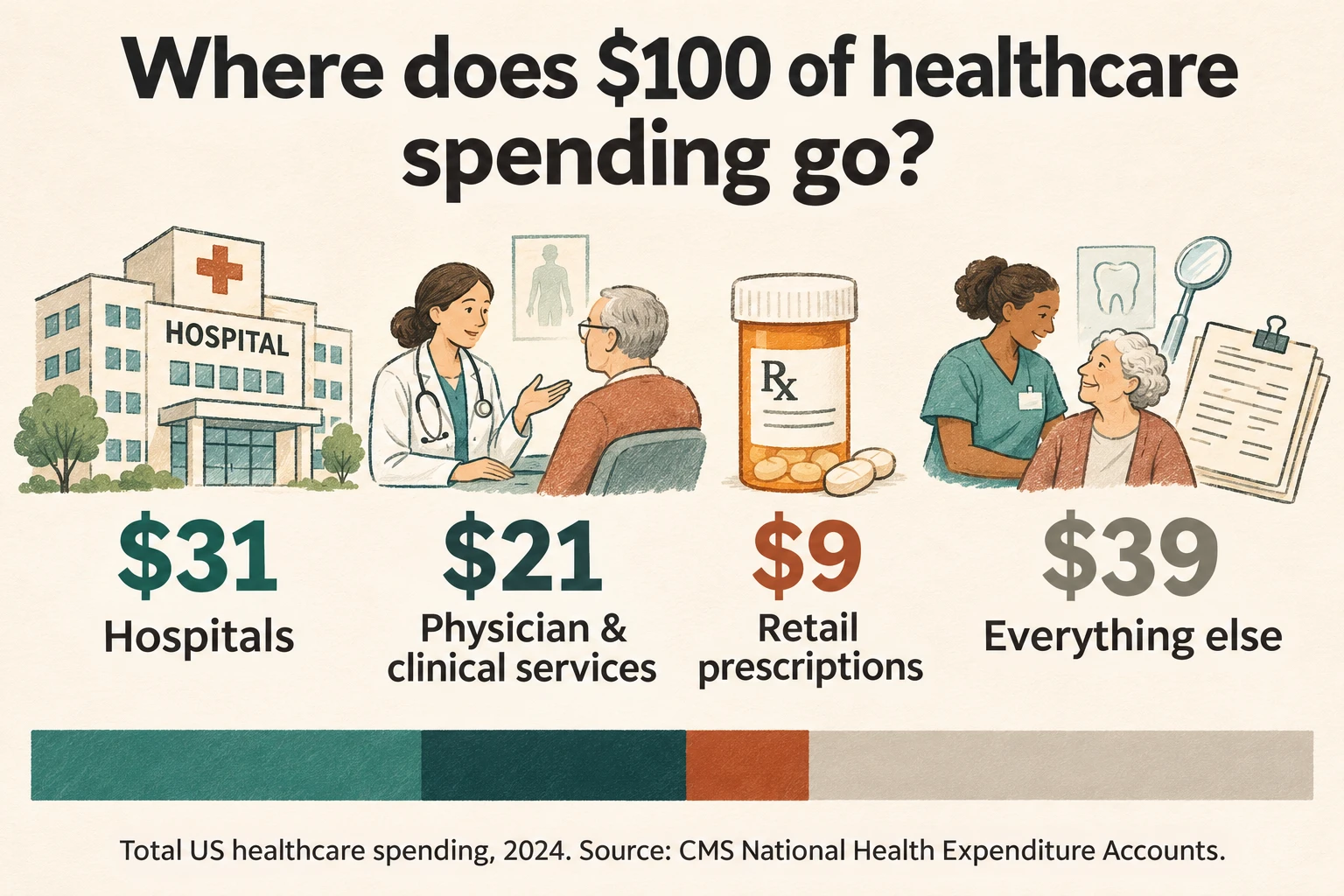
$3,400 a month is roughly $40,000 a year in premiums. Adding an $8,000 deductible on top means the family would need to pay $48,000 out of pocket before insurance kicks in. It’s very unlikely for a family to spend that much on their healthcare a year. So where does that money go? Healthcare spending is very skewed. 1% of Americans account for 22% of total spending and the lowest spending half of the population accounts for only 3% of total spend. That means your family is most likely to be in the 3% of total spend and you’re subsidizing the unhealthier part of the population. To break the healthcare dollar down even more, of every $100 spent in the US, $31 go to hospitals, $21 to physicians and $9 to prescriptions. The spend is skewed both across the population and care categories, but it gives us a better insight into what are the biggest drivers of price increases.
Whenever people get angry about rising health insurance prices, the main blame goes to insurance companies. People assume they are making big profits and that’s why the prices are increasing every year. In reality, the story is a lot more complex. Health plans that individuals buy must, by law, pay out at least 80% of the monthly premium for healthcare costs. So, if your premium increases 5-15% a year, that is mostly due to healthcare costs increasing for the carrier, not their profits getting bigger. Let’s dig deeper into what is behind the rising healthcare prices.
When health insurance companies plan premiums for next year they look at running costs compared to predicted costs for the current year and extrapolate how they need to price the plan to make the actuarial math work. Consumers picking plans from the ACA marketplace are very cost conscious, which is why each carrier tries to price the plans as cheap as possible. Health plans are required by federal and state law to offer the essential health benefits and there’s no benefit to offering anything on top of it because it would increase the premium. Thus, the benefits are rarely changed from year to year and the repricing mostly happens on the level of how much usage and actual care delivery costs in the predicted year.
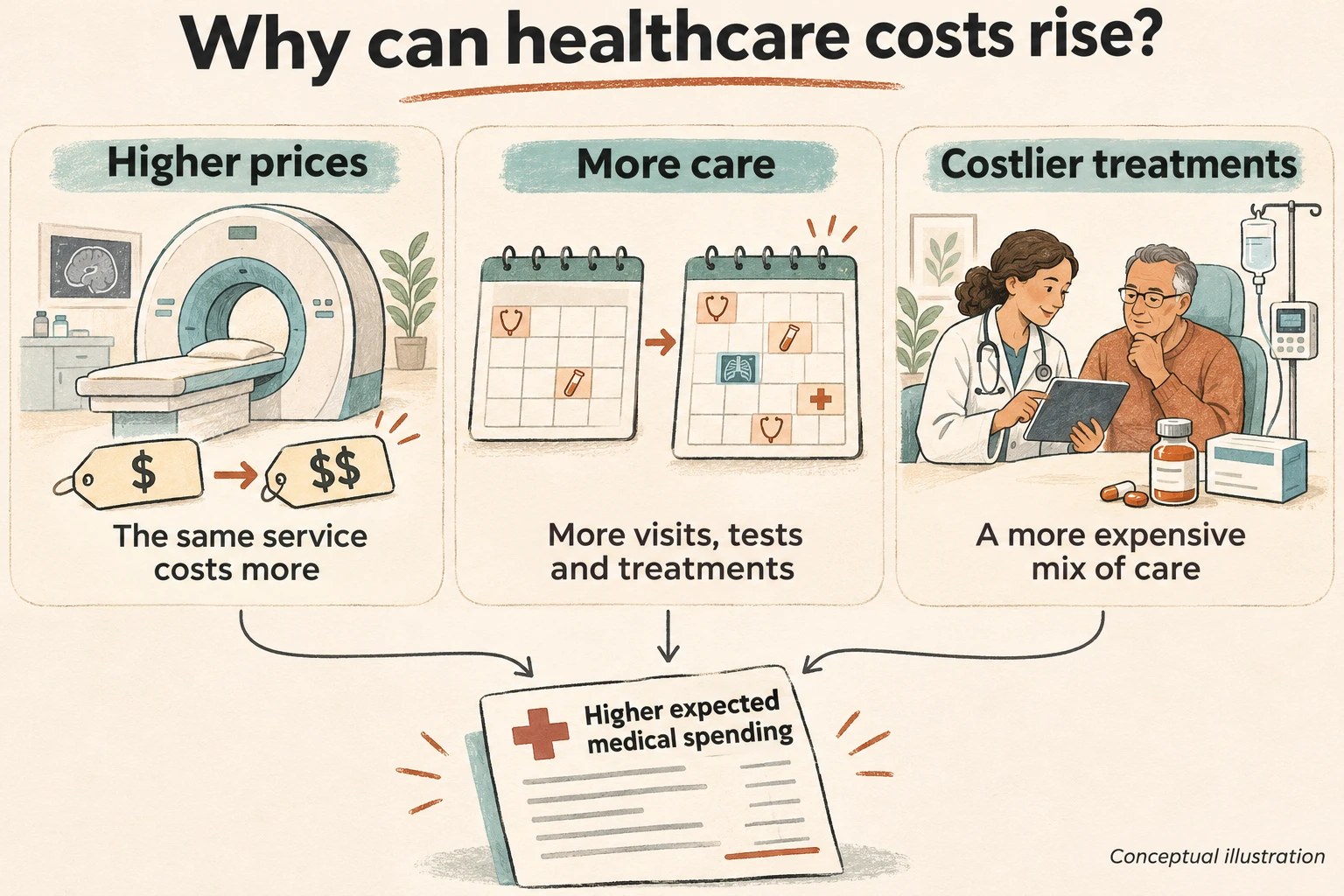
Health plans need to publish what goes into the price of every year’s premium. For example, for individual health plans in Vermont for 2027, a carrier projected medical spend to rise 5.5%, prices per service to rise 3% and the intensity of care rising 2.4%. Those costs are rising independently of the carrier’s own operating expenses and thus they need to pass those price increases through to the consumer to make the math math. The final premium also depends on who enrolls in the plan, but that’s outside of the carrier’s control. It’s one example where despite the carrier’s best efforts they have to raise prices 10-15% to provide the same promised services to their members in 2027.
Hospital visit costs get determined between carriers and hospitals through price negotiations. Those prices are affected by supply and demand. If the hospital is the only one in the area, they get to demand higher prices. If there are many health systems competing for the same patient, prices tend to be lower. The whole system is incredibly opaque though, where the same MRI can differ in cost multiple times within a 5-minute walk radius. That’s just a simple example of how the spend can be very different, despite the patient, the machine and the scan being exactly the same.
Why do usage and delivery costs change? Healthcare needs are pretty consistent over time since the population by and large does not get much more or less sick. There are outlier events such as COVID which change costs unpredictably, but that’s rare. There are also healthcare trends which change usage patterns such as increased awareness of mental health care or GLP-1s. These do change total costs of health plans and thus many plans end up restricting access to those benefits to keep the costs down. Sometimes, new therapies are so expensive that plans exclude them altogether like gene therapies and GLP-1s. Again, not because they don’t want to offer additional benefits, but because low premiums are the main selling point for health plans.
The second reason why premiums are rising is because the costs of typical procedures are increasing. Recently, providers have aggressively started using AI scribes and charging more for the same service. Providers can charge insurance companies more depending on the severity of the services provided and AI scribes optimize for the highest possible reimbursements for each visit. In recent years, the severity of visits has increased significantly and so have costs for the same services. That has ended up increasing the premiums despite the population not getting any sicker. It’s likely that insurance companies will soon start using more AI to try to fight back on those charges, but it will be a cat and mouse game with no clear solution in sight.
On top of these trends, there are more marginal changes such as emergency care getting much more expensive due to new out-of-network billing rules. Those things might be solved by new laws being passed, but in general, it’s just an example that healthcare prices are influenced by lots of different factors that are independent from each other. There are lots of service providers and innovation trying to reduce costs across different categories of care, but I will dedicate another blog post to that.
For completeness, I should also add that there are cheaper alternatives to fully regulated health insurance plans that also provide similar coverage for less, but come with fewer legal protections for the members. Examples include healthcare ministries, healthshares and healthcare crowdfunding platforms. They are all cheaper alternatives, normally coming with certain limitations for coverage, but tend to work well as long as you’re a relatively healthy individual.